Roman Legionary System – Structure, Development and Use
 The Development of the Legion
From the legendary foundation of Rome in 753 BC until the beginning of the 5th century BC, plebeians and patricians lived in relative harmony. Despite their different levels of wealth, they worked their fields themselves. In times of war, however, it was almost exclusively plebeians who took up their “own” weapons and went to war. Even at this time, the structures of the later legions familiar to us could already be recognised.
The one-sided recruitment inevitably led to further impoverishment of the plebeians and an increase in patrician power. After revolts, it was agreed that elected representatives of the people (tribunes of the plebs) from the ranks of the plebeians would henceforth have a voice in political affairs.
Major reforms of the military system became necessary by the Punic Wars at the latest (from 264 BC), which also encouraged the construction of a huge fleet.
At the end of the 2nd century BC, Marius (156–86 BC) transformed the citizen army into a professional army. This development is regarded as the birth of the most successful army of all time.
For the first time, standardised weapons and equipment were introduced. This created many new jobs and encouraged the development of a large-scale arms industry. At the same time, all military formations were reorganised and structured.
The legion (Legiones) formed the phalanx of the Roman military system. They were elite units deployed in wartime only when operationally required; in general, legions were stationed in the peaceful hinterland.
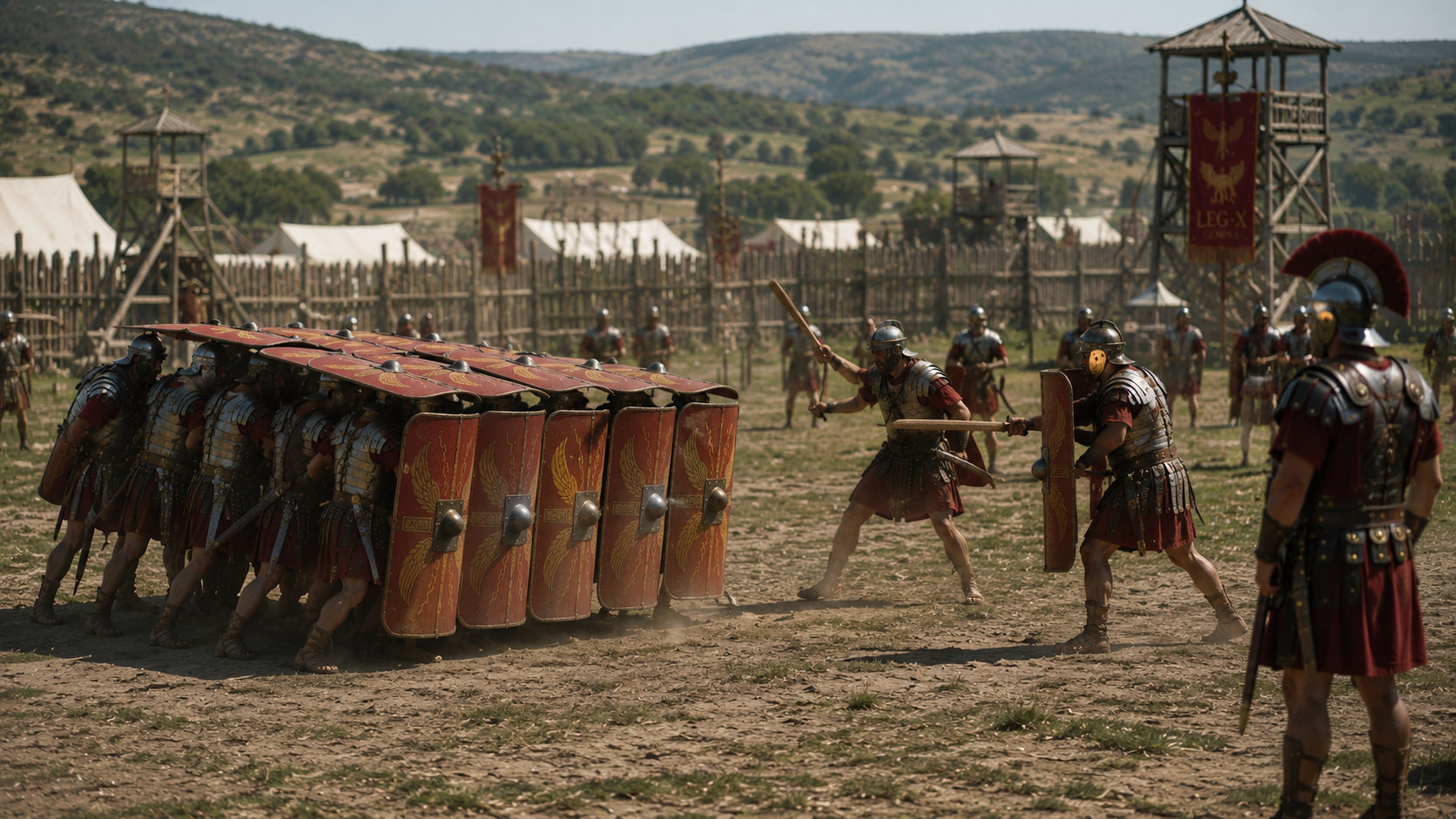
For centuries, legions were recruited exclusively from Roman citizens. Legionaries underwent rigorous training and served for 20 or 25 years. Active service lasted 20 years, while the remaining five years were a form of reserve duty. Centurions, by contrast, almost invariably remained in service until the end of their lives. During this period, a “semi-retired” veteran could still be called up in wartime. After completing their full service, legionaries received their remaining pay (the military fund) and a piece of land.
Auxiliary troops (Auxilia), on the other hand, were recruited from inhabitants of the provinces and were considered “non-Romans”. When an auxiliary soldier completed 25 years of service, he received Roman citizenship, which was passed on to his family. A descendant could therefore enter the regular legions. The auxiliaries were responsible for frontier surveillance and security. In battle, auxiliary formations were deployed first. Visually, they differed from regular legionaries only in small details, for example flat hexagonal or flat oval shields. Recent research indicates that their armour and most of their weapons must have been identical to those of the legionaries. The auxiliary forces also included famous specialist units whose military roles reflected the particular abilities of their regions. Archers, for example, came from Syria. Cavalrymen came from Thrace, Iberia and Gaul. Germans were mainly employed as spearmen. To prevent possible uprisings or to ensure that auxiliary units could not turn their knowledge against the Romans themselves, they were transferred to other countries.
A cavalry unit (ala) was organised differently from a legion in terms of numbers and structure and initially played a smaller role. Through its development, however, it gained much greater importance over the centuries and became almost equal to the legion.
According to legend, the Roman navy arose by chance. One day a Carthaginian bireme was stranded on the Italian coast. The Romans analysed this type of ship, and their powers of observation and logic served them exceptionally well. They reproduced the design while adding their own ideas and foresight. Their version included several technical innovations, notably a boarding bridge, a ram and a tower that was later even built in stone. With this technically superior design, Rome gained command of the sea and retained it for centuries.
Estimates suggest that in the imperial period Rome had two major fleets of 250 large, heavy warships each and four smaller fleets with a total of 500 ships (figures may vary). Two fleets were stationed in the Mediterranean. One fleet was based in the English Channel and another in the Black Sea. The others were stationed on rivers. These units consisted mainly of Liburnians and some biremes, with a trireme serving as flagship for each fleet. Their commander was a military prefect (admiral).
Because legionaries and specialist units were distributed among the many ships, it was essential to adapt the organisational structure of the naval troops to that of the land forces.